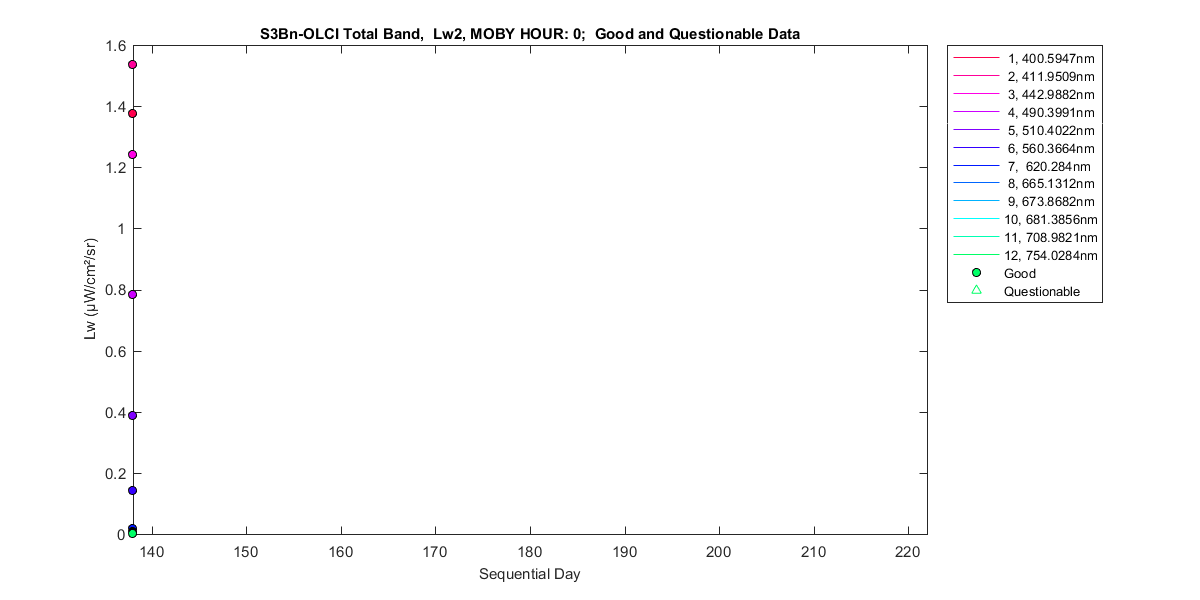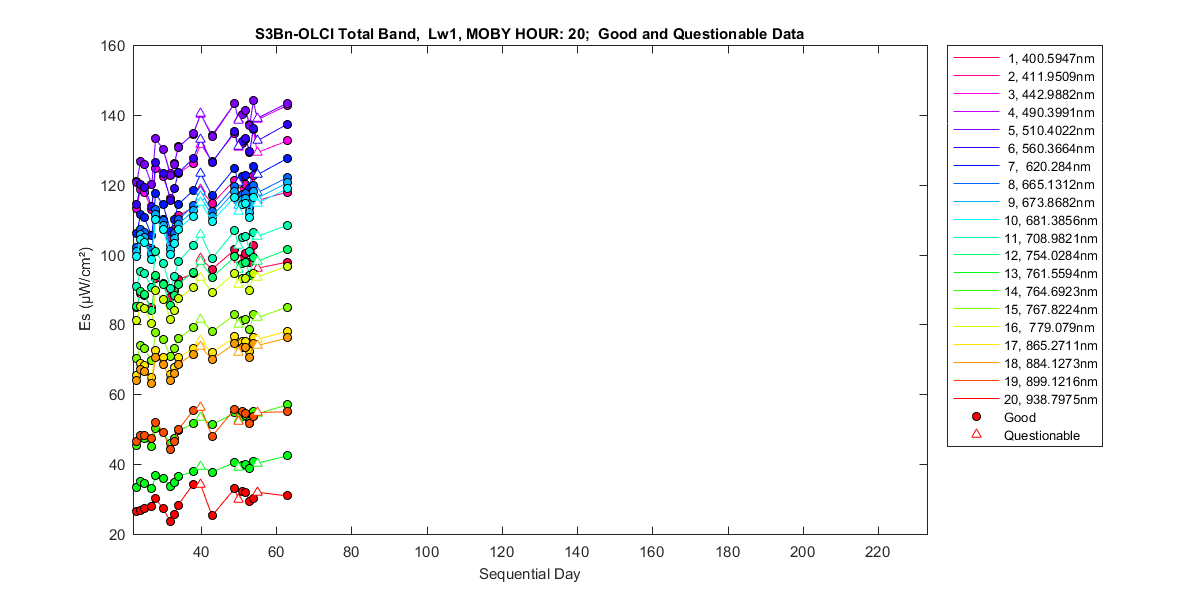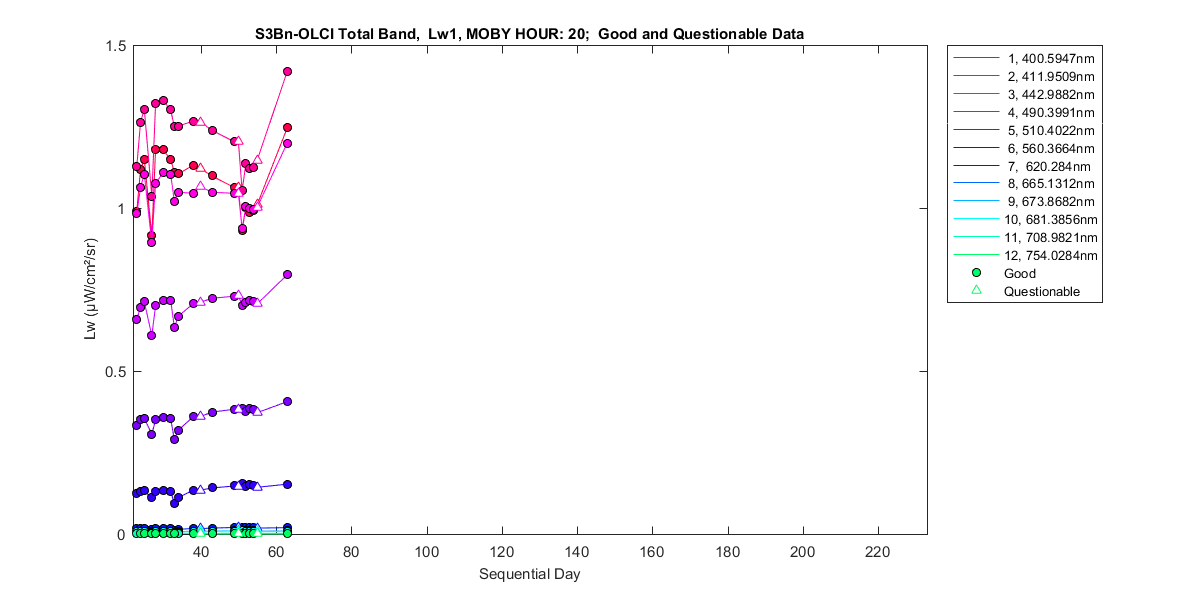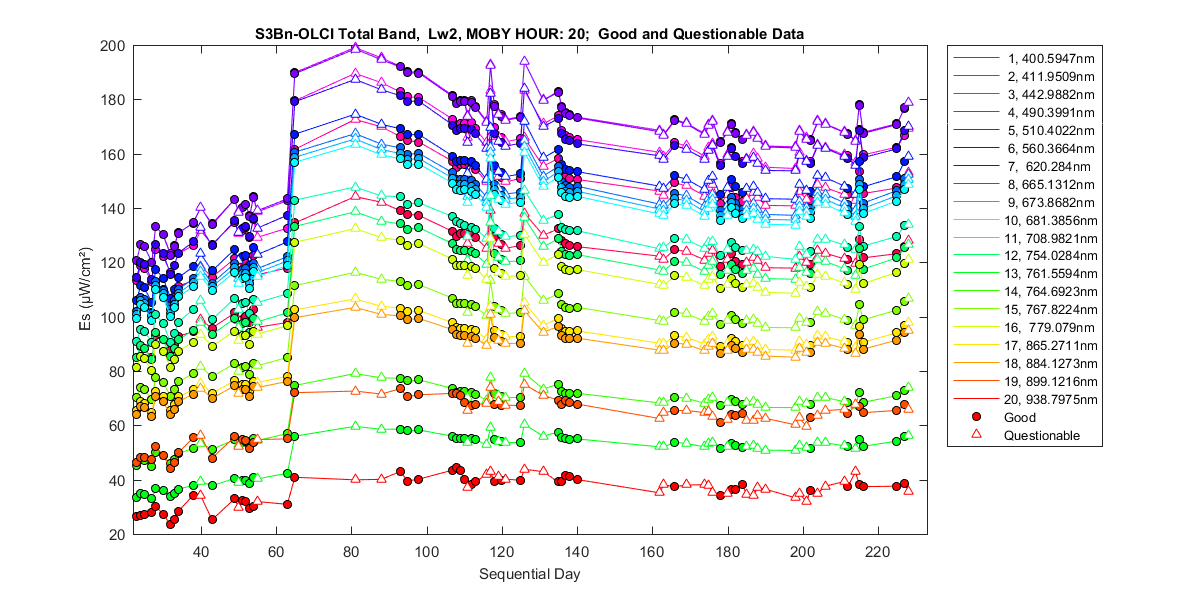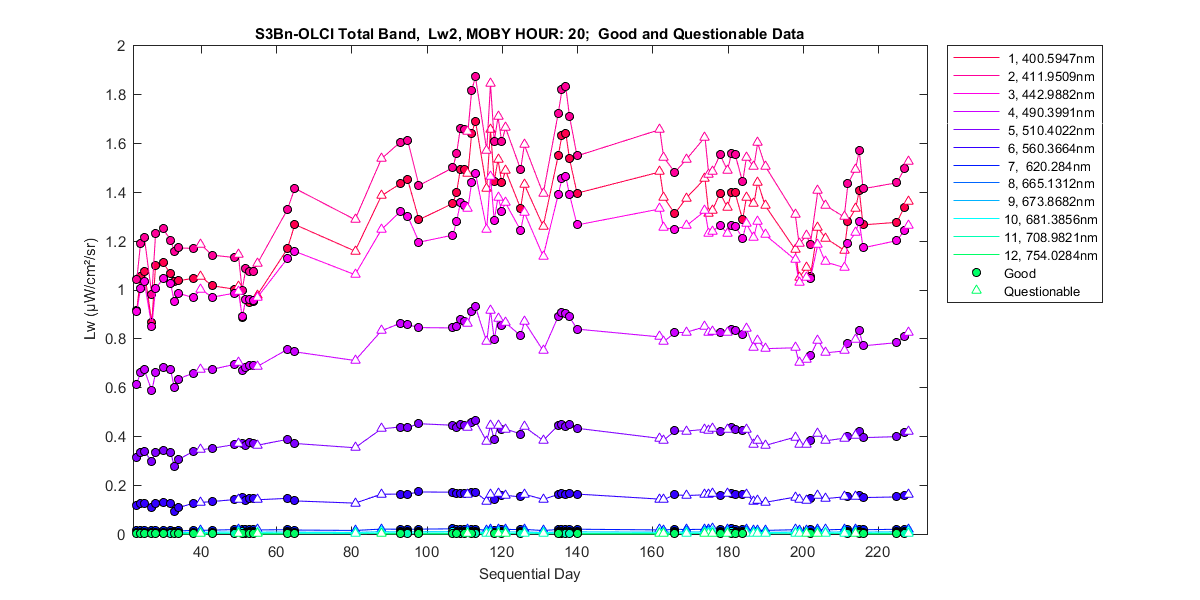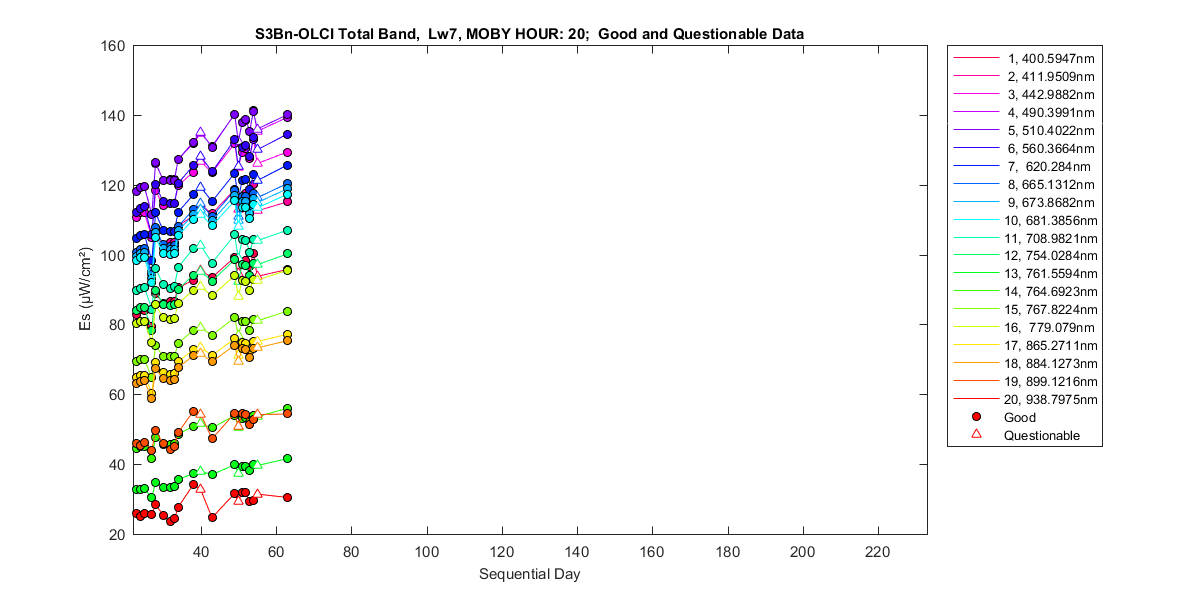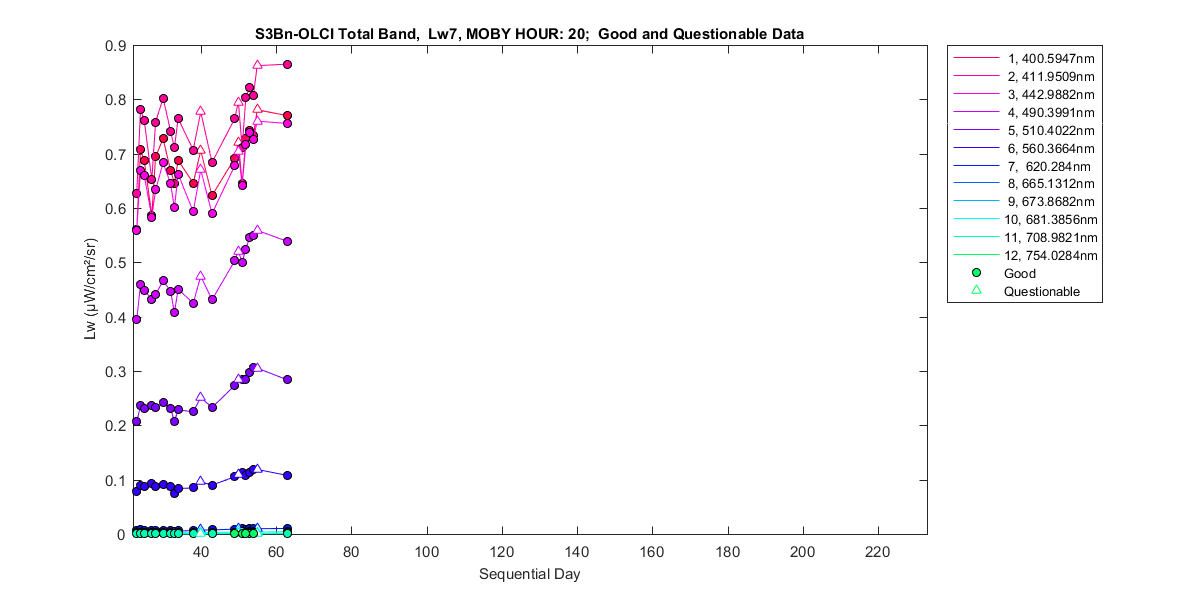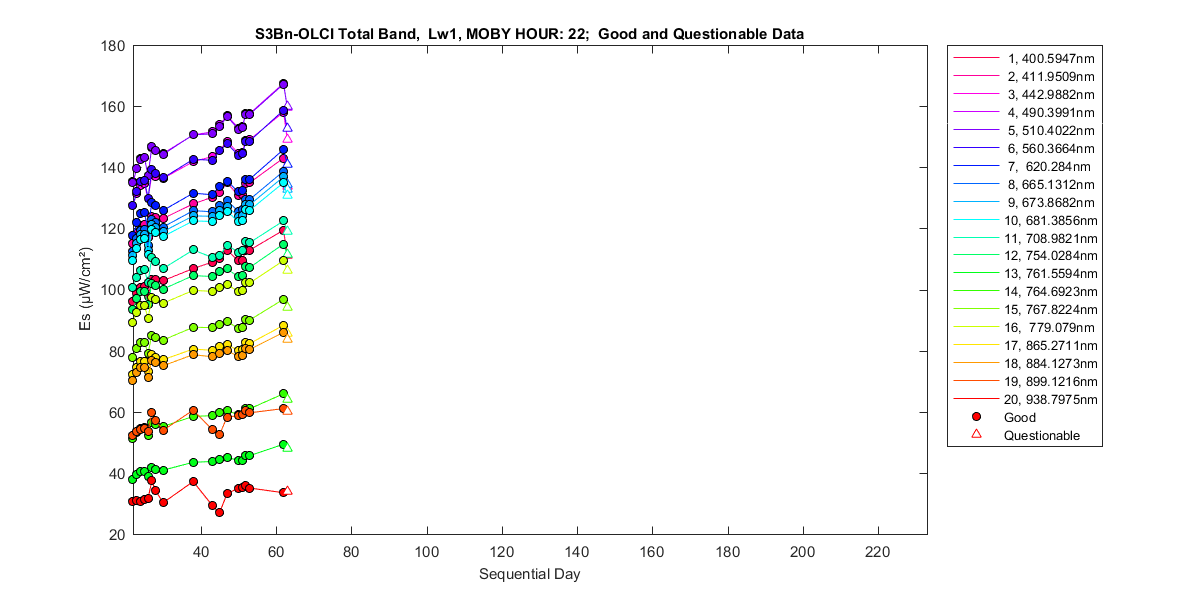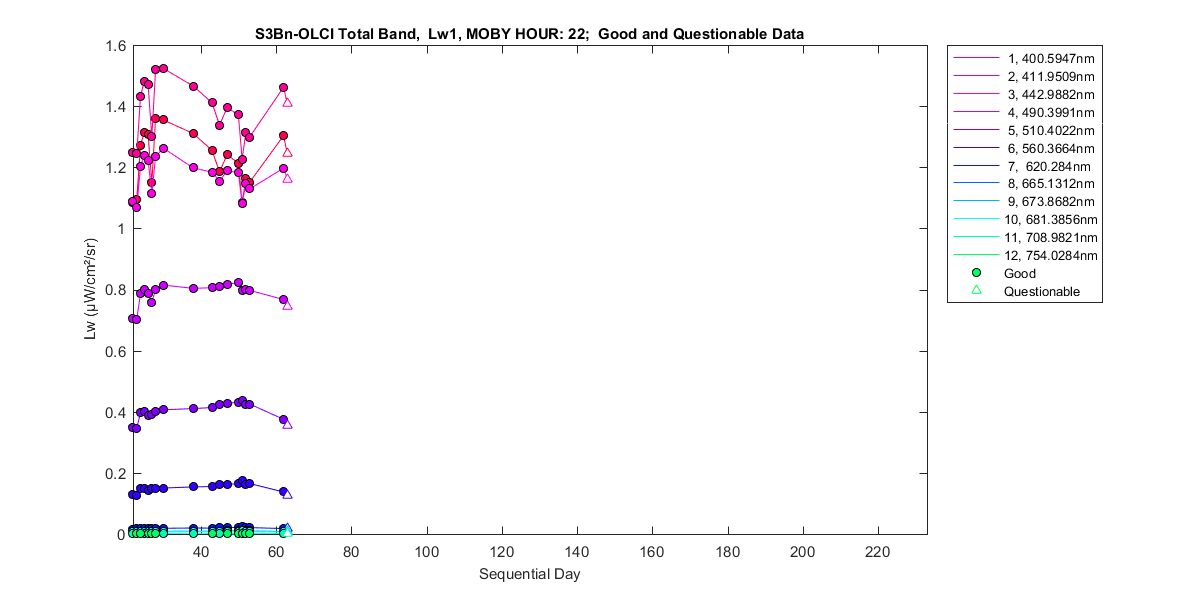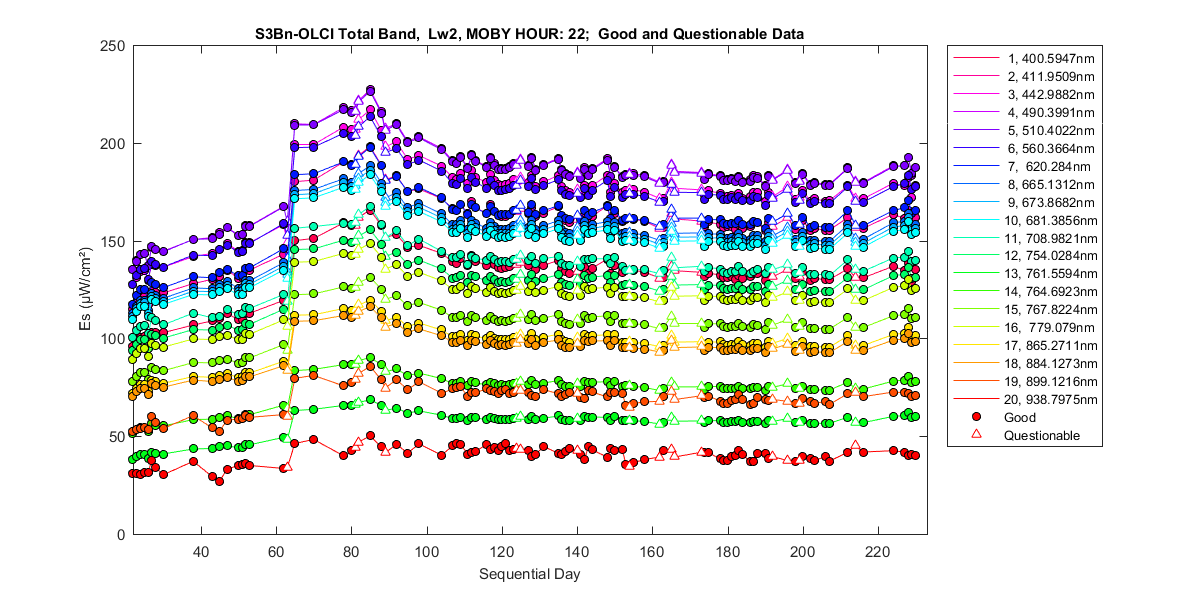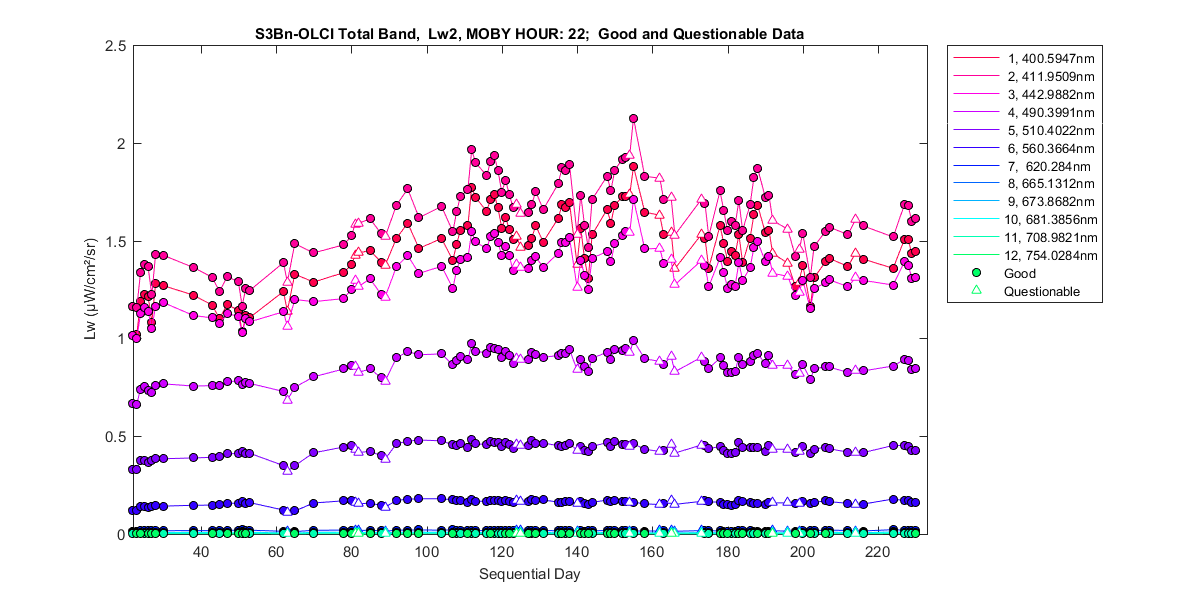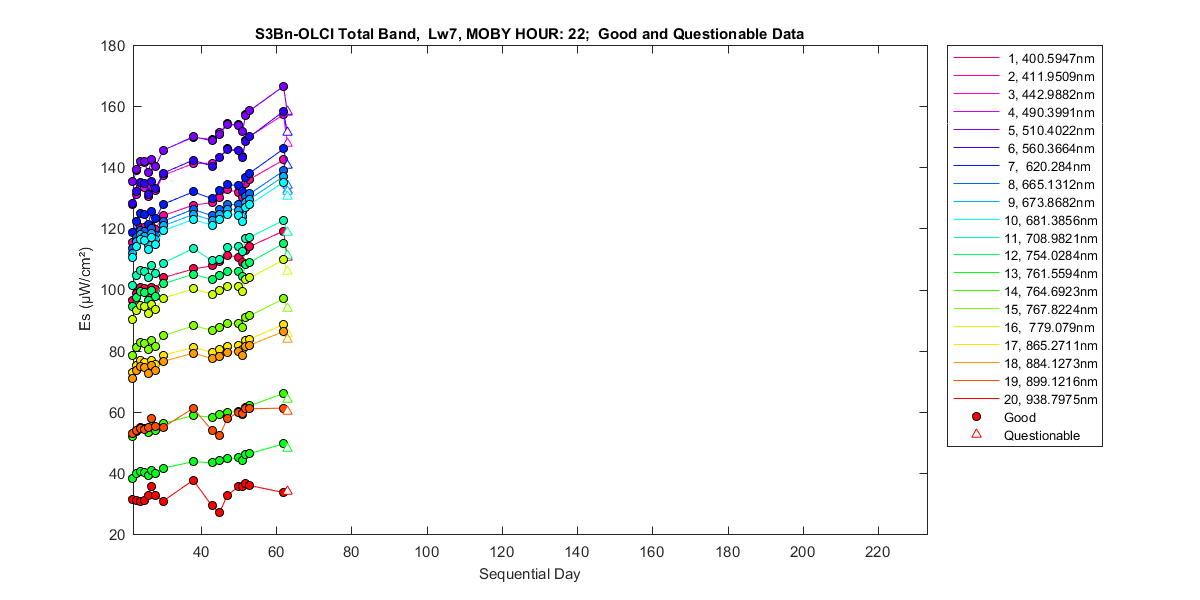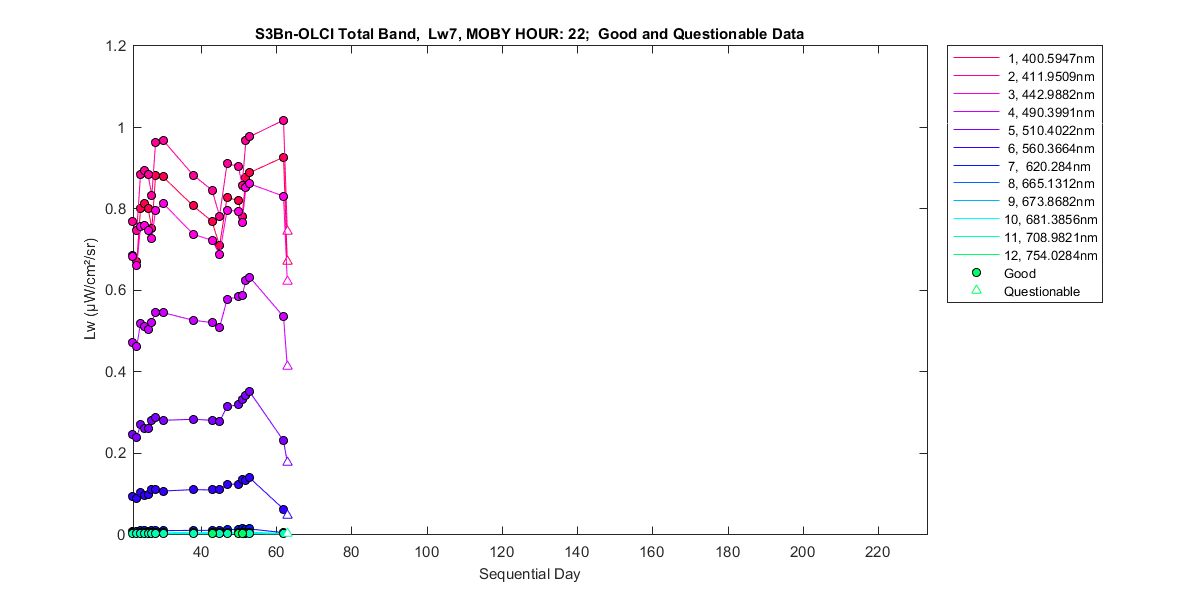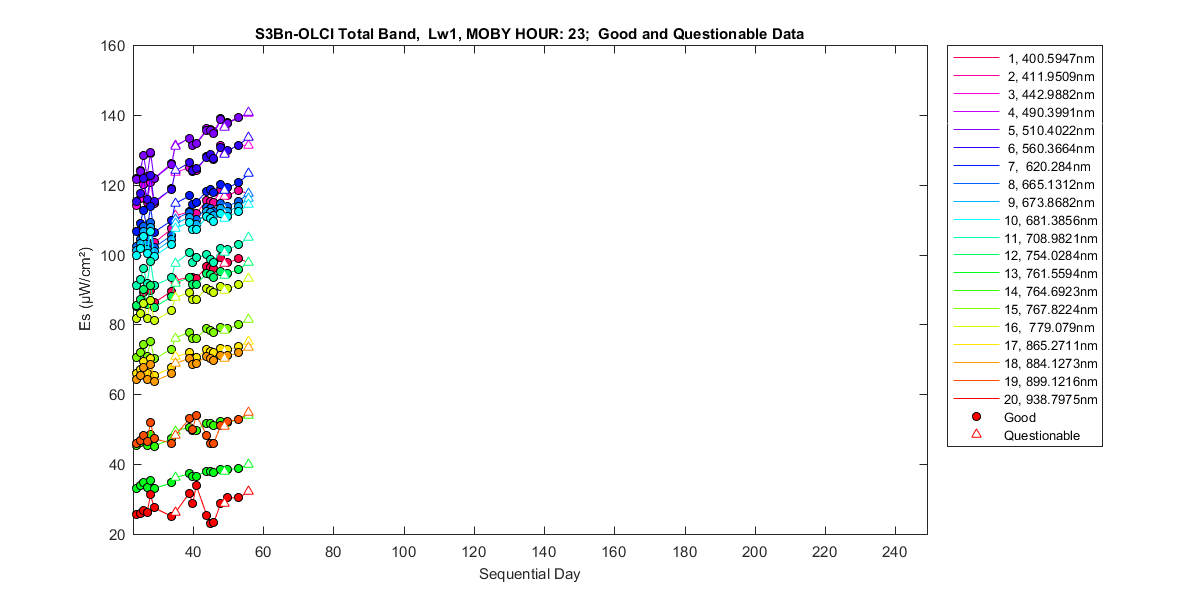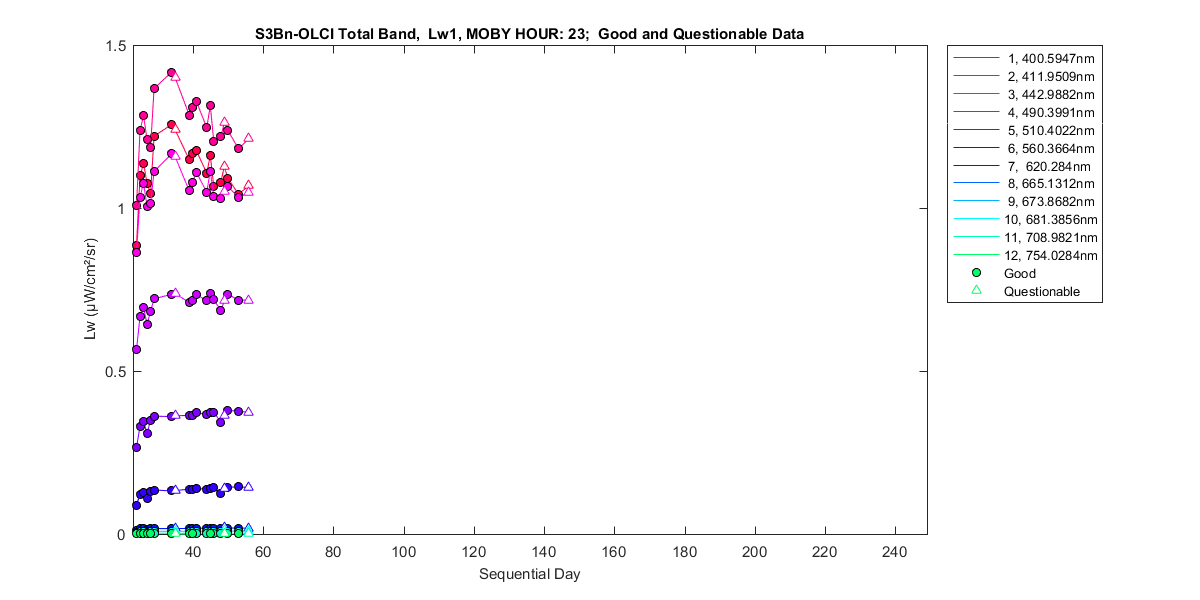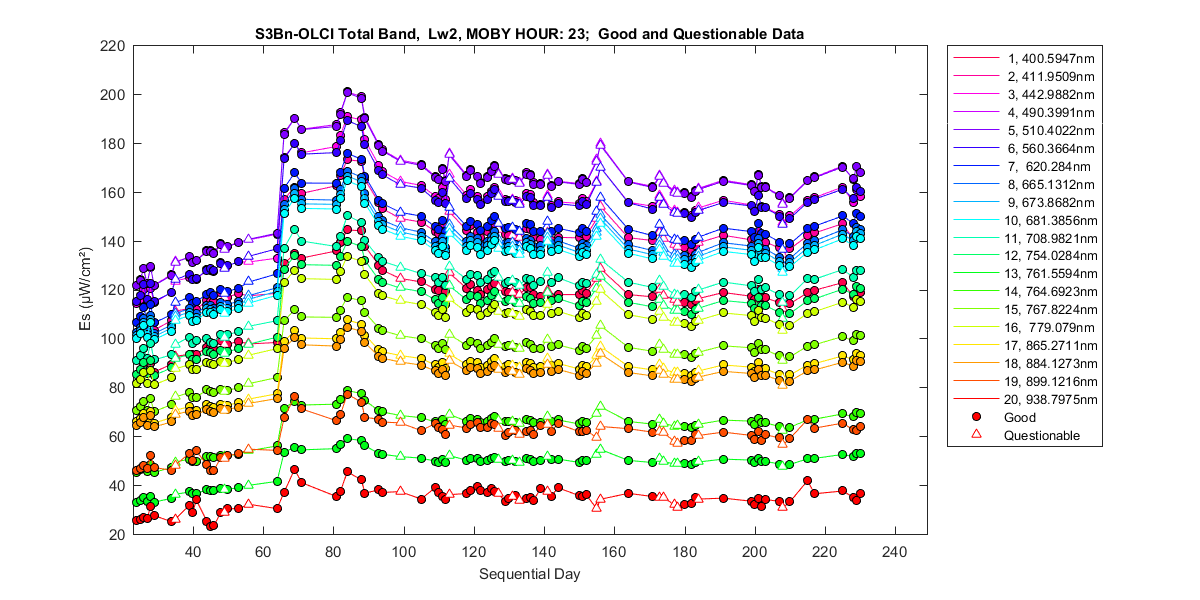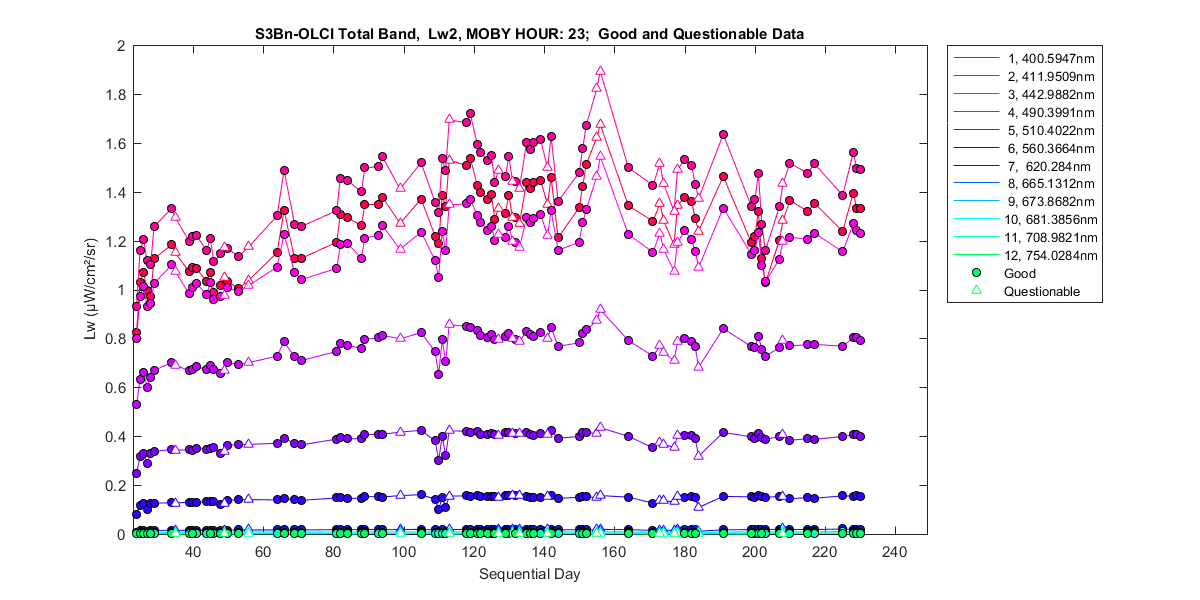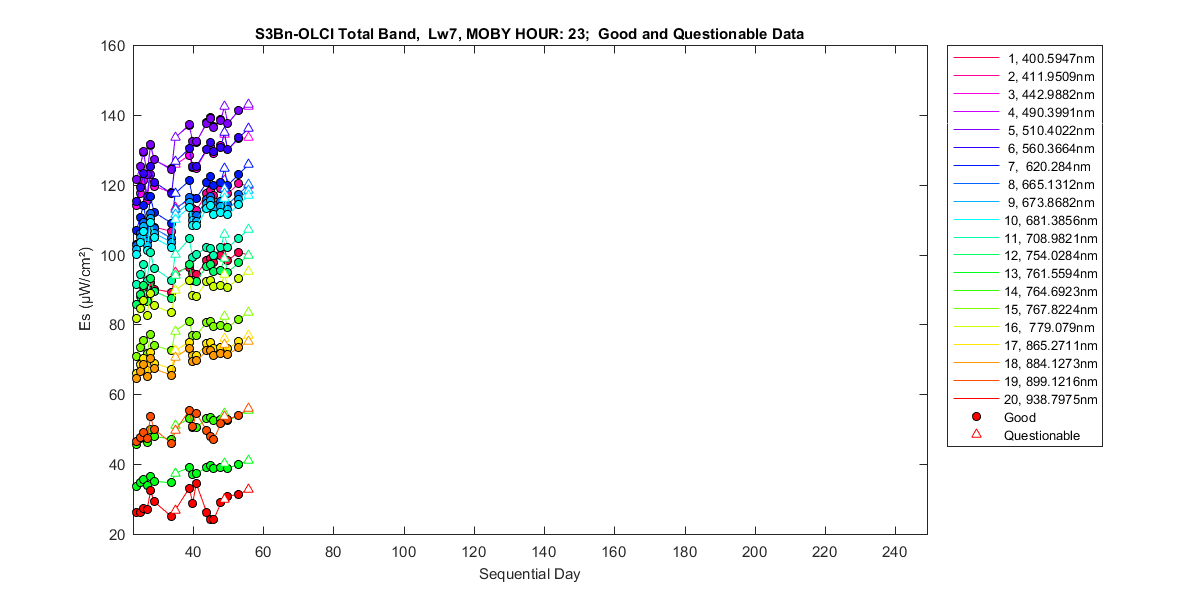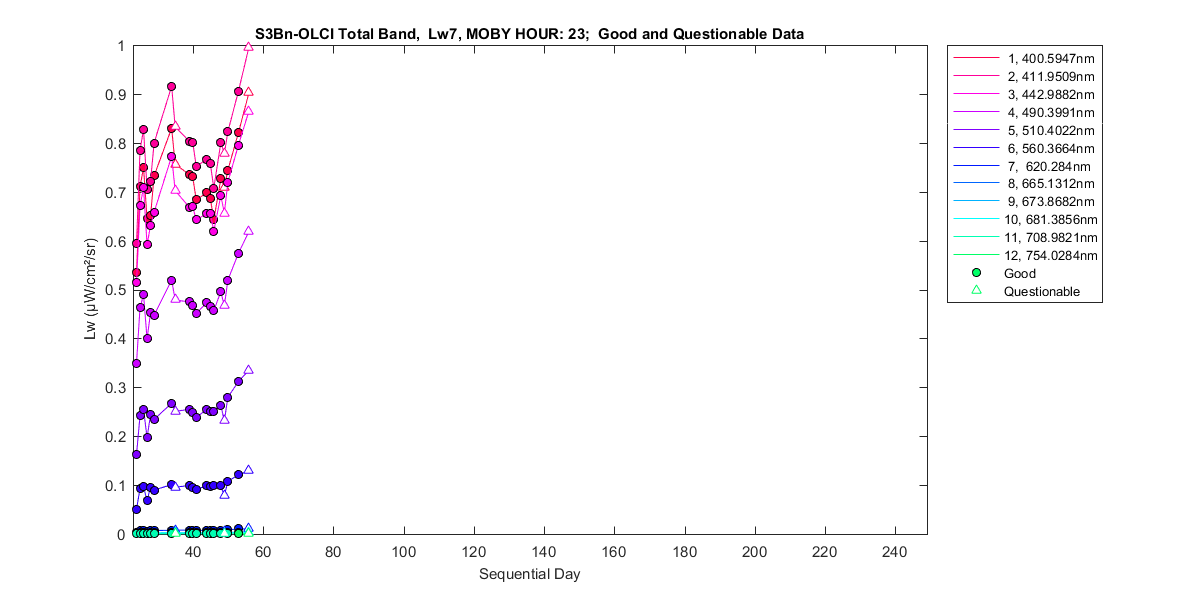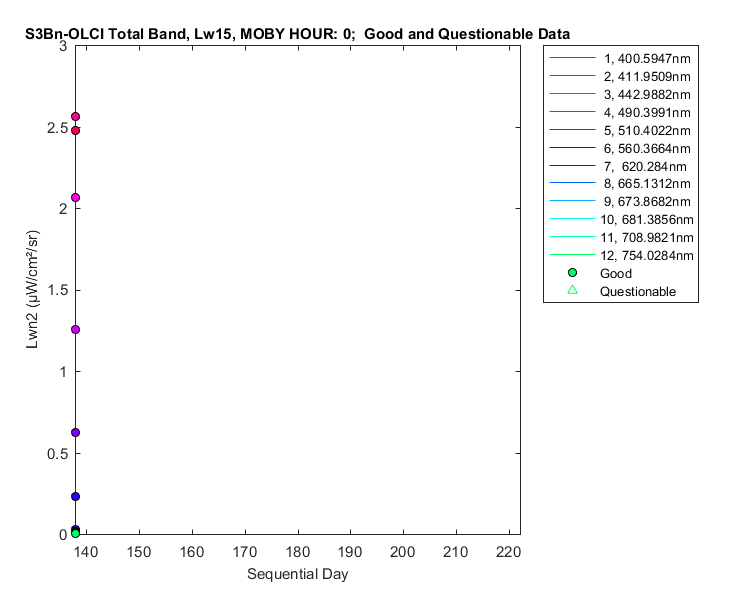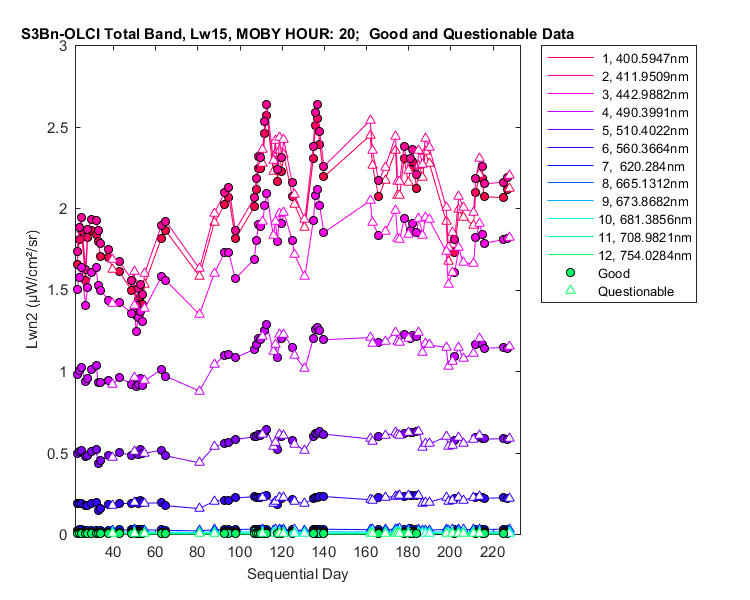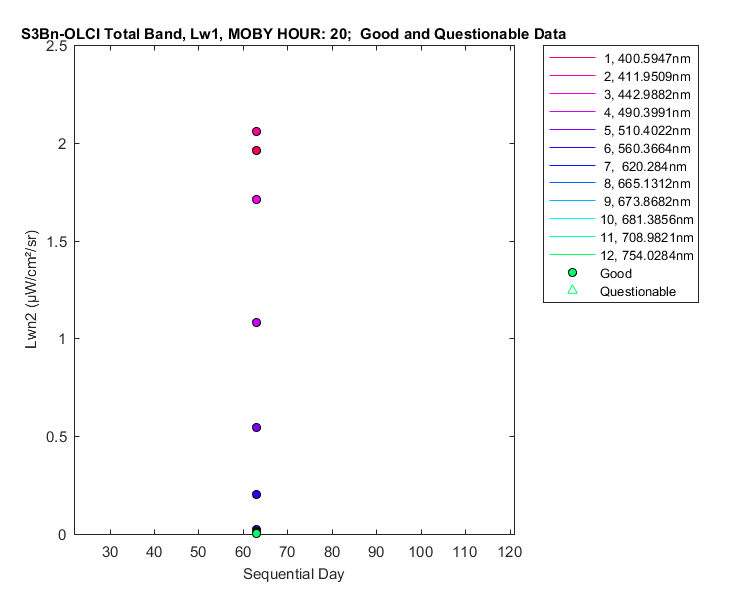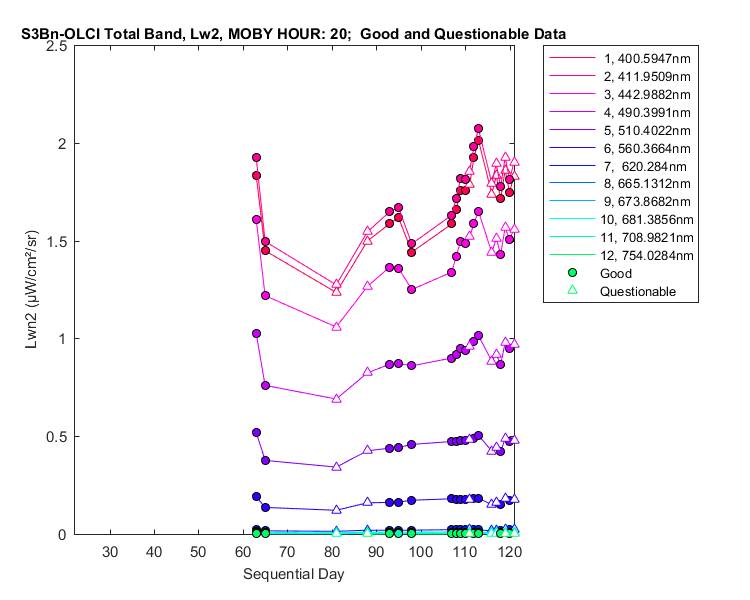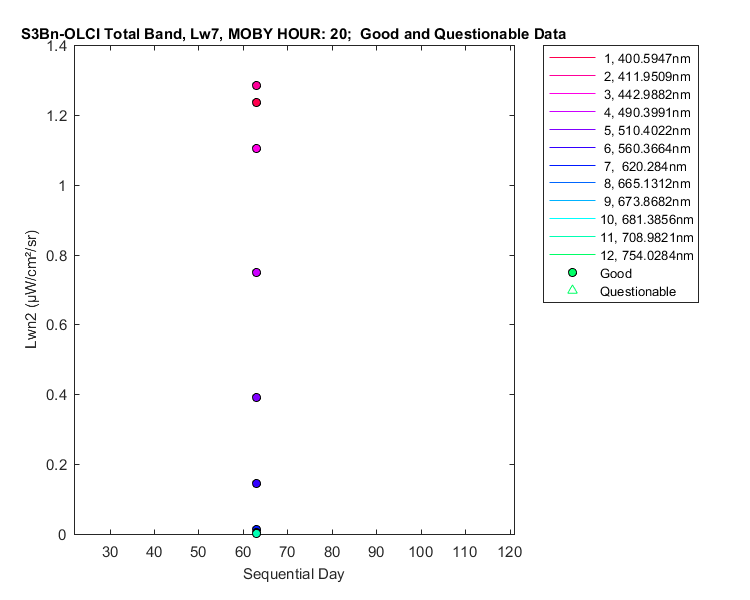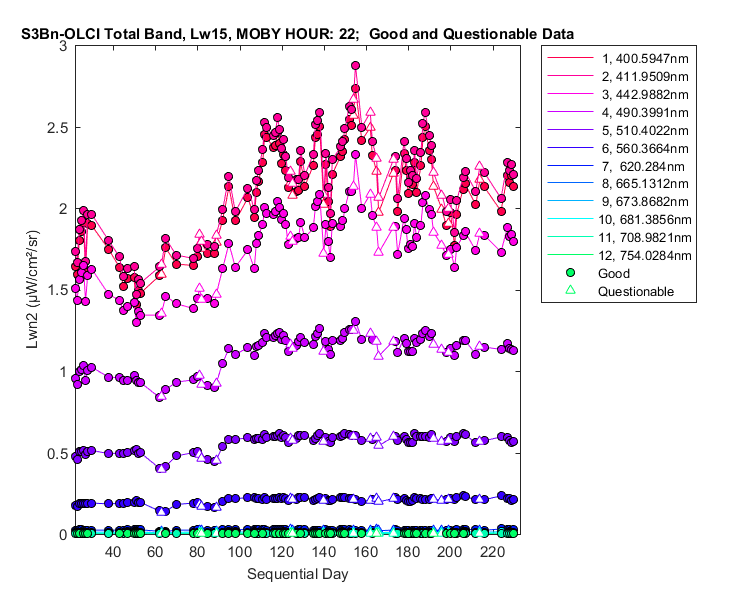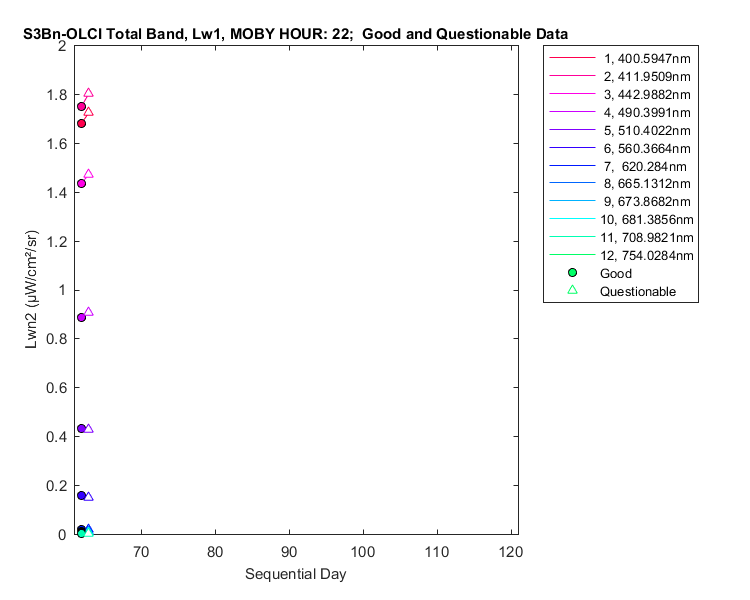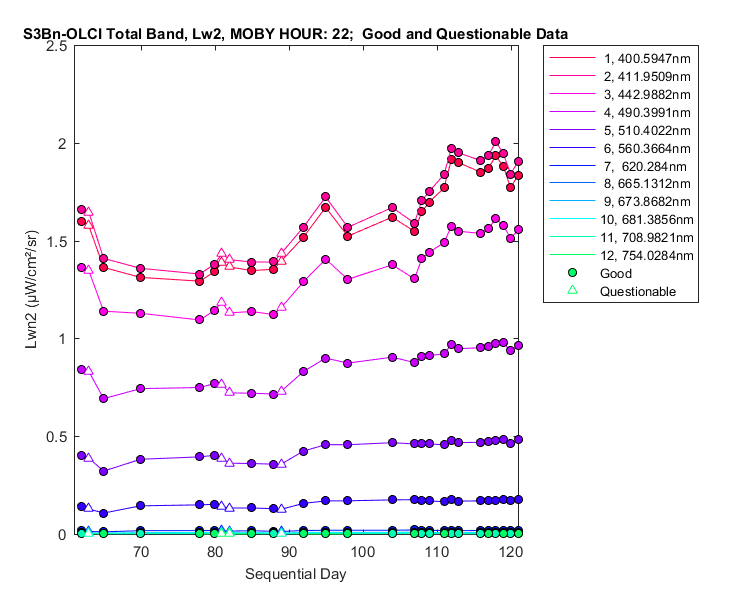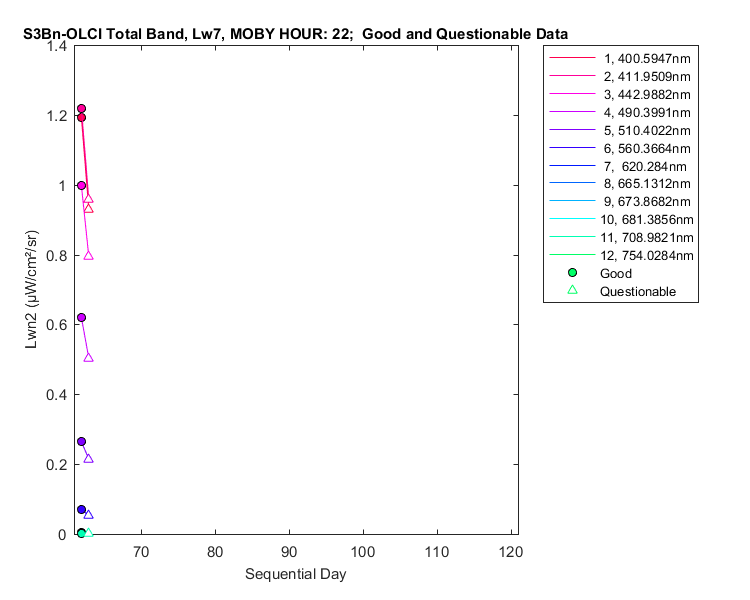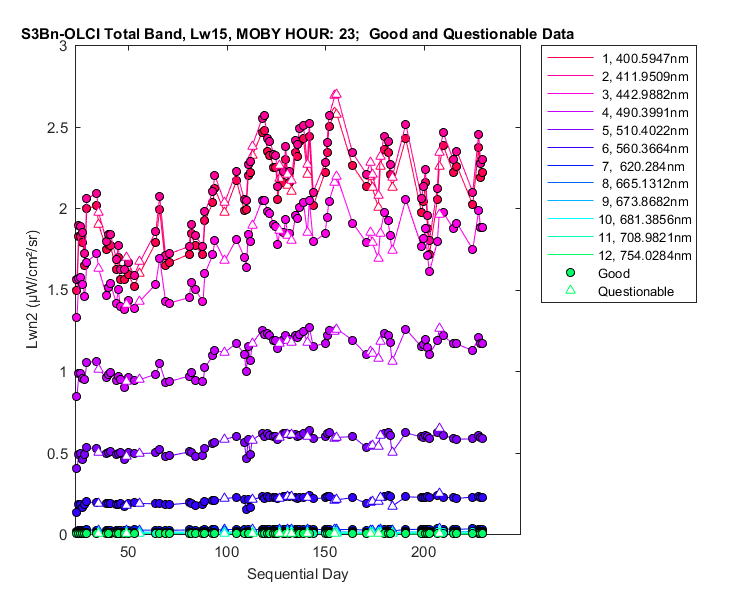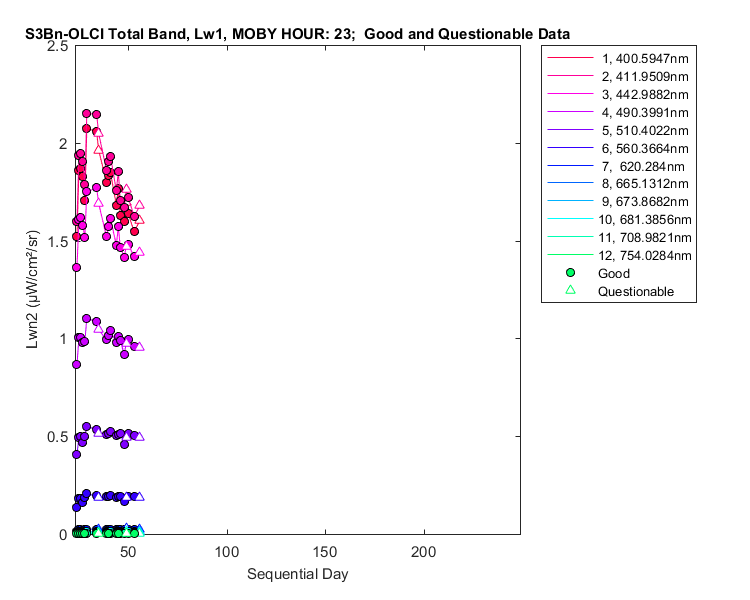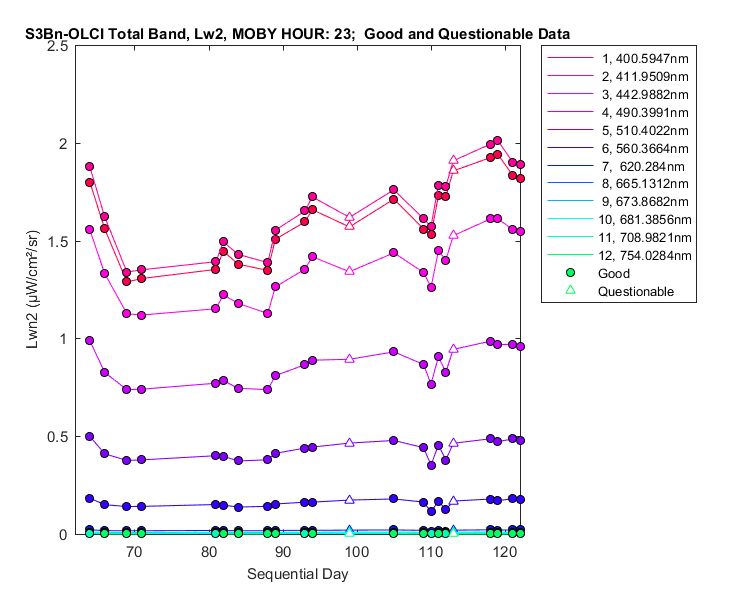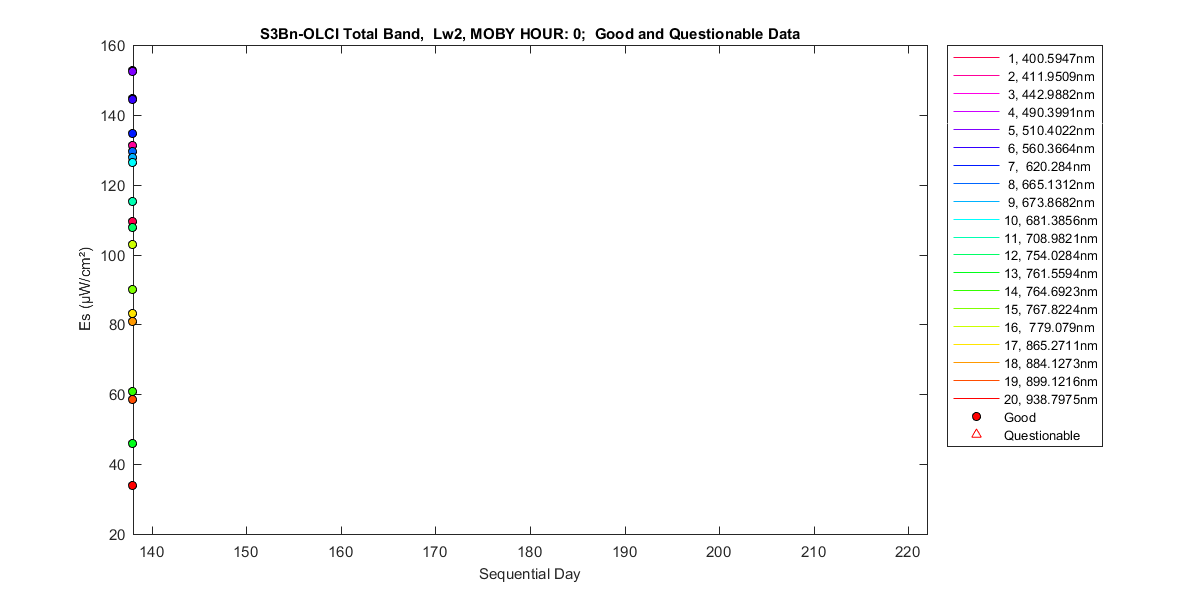
Satellite band averaged data: water-leaving radiance, surface irradiance and solar normalized water-leaving radiance. These values are given as the mean flux (not the total flux) for each band. The total and in-band averages are calculated for each satellite. The in-band is calculated by limiting the relative spectral response to within 1% of the maximum value. A separate data listing (denoted by it's hour) is presented when MOBY collects more than one file per day. Six water-leaving radiances can be calculated from different combinations of MOBY four radiance collectors. The best water-leaving radiance is Lw1, determined from the upper two arms. Lw7 is also included and is calculated from the middle and bottom arms.
This deployment had several changes occur over time.
At the beginning of the deployment we felt that LuBots calibration was not good, but the post calibration confirmed the precalibration of LuBot so we will produce Lw2 for the deployment (the product which uses LuTop and LuBot).
The Es sensor changed drastically between March 5th and April 29th, but seemed stable before and after this period. Thus we are using the precalibration for Es for the period before March 5th, and the post calibration for data after April 29th. For the period between these two dates we will not post any Lwn products nor the Es data.
On March 5th the LuMid sensor started failing (we found, after the deployment, that part of the system had flooded). Hence we only have Lw1 (which uses LuTop and LuMid) up until March 5th.
In summary:
Beginning of deployment until March 5th we are producing Lw1, Lw2, Lw7, Lwn1, Lwn2, Lwn7 and Lw15 (and Lwn15 ... these use historical KL values). For the period between March 5th and April 29th we are producing Lw2 and Lw15. For the period from April 29th to the end of the deployment we are producing Lw2, Lwn2, Lw15 and Lwn15.
● October 2016 Reprocessing Information
In Oct 2016, a reprocessing of the MOBY data began. Three problems are being addressed: 1) the method to extrapolate Kl to the surface has been improved to include Raman scattering and chlorophyll fluorescence; 2) the arm depths used in retrievals was increased by 0.234 m; and 3) a single pixel shift in the data for the RSG collected at a bin factor of 384 for deployments MOBY203 to MOBY253. Initially only MOBY254 to current deployments were reprocessed. These deployments did not have the RSG single pixel shift problem. So for MOBY254 to current deployments only correction 1 and 2 are applied. As the older deployments are processed the data will be added to this directory. MOBY203 to MOBY253 will have had all three corrections applied.
| Satellite Band | Hour | Lw&Es | Lwn2 |
|---|---|---|---|
| S3Bn-OLCI Total-Band | 20 | 1 | 1 |
| 22 | 1 | 1 | |
| 23 | 1 | 1 | |
| S3Bn-OLCI Total-Band | 00 | 2 | 2 |
| 20 | 2 | 2 | |
| 22 | 2 | 2 | |
| 23 | 2 | 2 | |
| S3Bn-OLCI Total-Band | 20 | 7 | 7 |
| 22 | 7 | 7 | |
| 23 | 7 | 7 | |
| S3Bn-OLCI Total-Band | 00 | 15 | 15 |
| 20 | 15 | 15 | |
| 22 | 15 | 15 | |
| 23 | 15 | 15 | |
| S3Bn-OLCI Total-Band modeled Kl | 20 | 21 | - |
| 22 | 21 | - | |
| 23 | 21 | - | |
| S3Bn-OLCI Total-Band modeled Kl | 00 | 22 | - |
| 20 | 22 | - | |
| 22 | 22 | - | |
| 23 | 22 | - | |
| S3Bn-OLCI Total-Band modeled Kl | 20 | 27 | - |
| 22 | 27 | - | |
| 23 | 27 | - | |
| S3Bn-OLCI Total-Band modeled Kl | 00 | 215 | - |
| 20 | 215 | - | |
| 22 | 215 | - | |
| 23 | 215 | - |
| MOBY Hour | Lw | Aux Data |
|---|---|---|
| 00 | 2 | Listing |
| 20 | 1 | Listing |
| 20 | 2 | Listing |
| 20 | 7 | Listing |
| 22 | 1 | Listing |
| 22 | 2 | Listing |
| 22 | 7 | Listing |
| 23 | 1 | Listing |
| 23 | 2 | Listing |
| 23 | 7 | Listing |