SQM Problem 5. There is little UV because the window is glass and the diffuser is acrylic. Solution: replace both with fused silica (quartz)-based materials.
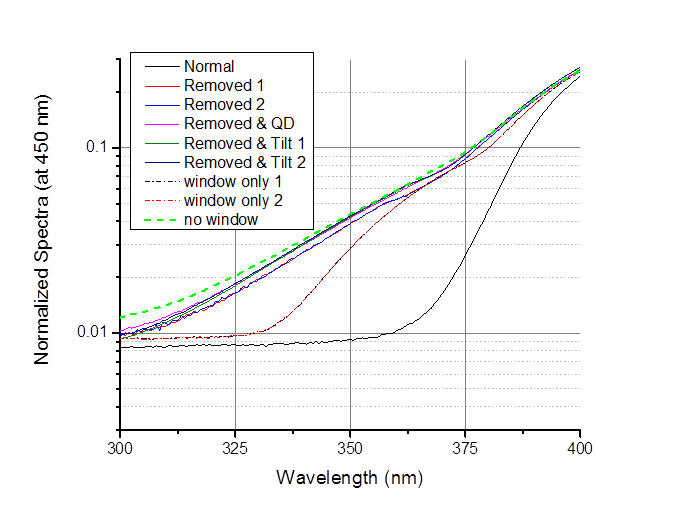
The first thing was to determine the relative spectral distribution of the YES SQM. I used the NIST UV CAS (200 nm to 875 nm). First, I made sure the UV CAS was working in the UV using a Hg emission lamp – yes the 253 nm line was clearly observed. Then, I made a series of measurements of the SQM with both lamp sets on and different configurations: a) window and diffuser; b) window only; c) bare lamps; and d) bare lamps, but with a 25 mm diameter “quartz diffuser” placed in front of the CAS’ 1.5 mm diameter fiber bundle. I say “quartz diffuser” because these are “found” pieces in my lab and I don’t know how they were made; they were in an optics box labeled “quartz diffuser”. They appear to be ground on both sides. The data were taken over several days, different integration times for the CAS, and different alignment for the bare lamps configuration. I normalized all results to 450 nm. The result is
Here, the solid black line “Normal” is the spectral distribution of the YES SQM and the dash-dot red and black lines are with the window and no diffuser. All the other results are some version of bare lamps, including the case with the quartz diffuser in the optical path. The conclusion is that the window and diffuser limit the output below 400 nm – by about a factor of 3.4 at 375 nm. Most of the decrease is from the acrylic diffuser (no surprise) but the window is also affecting the output below about 360 nm – at 350 the window decreases the flux by a factor of 1.4. I concluded both needed to be changed to quartz, since these test data show quartz is the same spectral distribution as the lamps/walls, and we can’t improve on that without changing the makeup of the chamber walls or the source type.
The next step was to measure the parts, and this was done in the NIST shops. The window is 9.914” +/- 0.005” diameter by 0.370” thick; the diffuser is 9.375” +/-0.005” diameter by 0.114” thick. The shops did not report a tolerance on the thicknesses, but instead said “best vendor effort” for the window and “actual” for the diffuser. These components are sandwiched between o-rings in the SQM and held in place with a flange.
The next step was to order a fused silica window and diffuser. The window was easy; it was supplied by GM Associates in Oakland, CA at a cost of $300 each (I got two). It has been delivered and it fits. The diffuser was more research. GM supplies a “32microinch” finish and they sent me a sample but this was too transparent. Discussion with the NIST shops led to the decision to order fused silica in the correct size and have the NIST shops grind the surfaces. We got 6 pieces at $200 each in order to have enough for experimentation. They also fit and were delivered to the shops on Sept 11, 2015. They should be ready for testing/integration in a few weeks.
Discussions with Yuqin Zong at NIST led to investigations of fused silica manufactured so as to incorporate bubbles or inclusions within the volume that act as scattering centers. Optical inspection of Yuqin’s samples indicates they could be quite good (Lambertian), although this is not a strict requirement for the SQM. I am interested in these materials not just for the SQM, but perhaps for the MOBY Es,d collector or to replace Spectralon reflectance targets. Three vendors have been identified, with differences in product size, purity, bubble size and density, etc. To date, I have ordered one diffusil S 500 part from opsira GmbH (Lambda Research Corporation, Littleton, MA, US distributor) with dimensions of 195mm +0.3/-0.0mm diameter by 2.9mm +/-0.1mm thick for $1250. To hold the 195mm diameter diffusil part in the SQM, and adaptor piece needs to be designed. I also anticipate meeting with Hereaus, whose material OM100 has been studied by PTB and the newer material HOD-500 is currently under study at GSFC. The third vendor is QSIL and the product is ilmasil.